Benefits of Parents Reading With Their Child
How monolingual parents tin can raise a bilingual child
The issue of parents teaching their children comes upwardly often and I've even had someone guest post on the blog most it earlier. That's smashing if you speak the languages yourself, but what if you are monolingual and still want to give your kid the all-time possible caput start in this wonderfully global earth?
Christine, who blogs at AlmostFearless and who has been travelling with her married man since 2008, has thought long and hard about this while she raises her own son, and is even writing a book nigh the feel. If you want to assist out, see details at the end of the post. Otherwise, enjoy her take on what parents tin can do to assist their children learn languages that the parents themselves don't speak fluently even so!
Over to you lot Christine!

I need your help. Skip to the bottom to see, merely first my story.
There was a contour of Ellen Bialystok in the NY Times a few years ago, and it came out only after my granddad had died from dementia. In the article, Bialystok, a researcher who focuses on bilingualism talked well-nigh her discovery that bilinguals and trilinguals gained about 4-v years before they started showing symptoms of memory loss from late-life diseases like Alzheimer's.
This report stuck with me because my grandfather, a Finnish-English bilingual, had led a long healthy life, until he got dementia — just it only appeared in his last twelvemonth. In fact he was at a condo in Florida outside of Palm Beach, that specific place because of the large Finnish population – they even have their own Finnish newspaper. It was through this strange bubble of Finnish speakers, both in Florida where he spent half the twelvemonth, and in surrounding area effectually his domicile in Massachusetts, that allowed my grandfather to employ both languages his entire life, decades after his immigrant parents died. Based on Bialystok's research, being bilingual might have given him 4 actress years of good health.
Shortly, with a child of my ain, I knew I wanted to be bilingual, if not just for me, to satisfy this long flirted with but never achieved goal, but for my son, who was immature enough to learn a 2d linguistic communication easily, permanently changing how his brain works, and potentially staving off the effects of late life retentivity loss, someday far in the future.
All material seems focused on bilingual parents
The first thing I did was to read about a dozen books on raising bilingual children, but I noticed something I hadn't expected… whether through design or market-demand, many of the books focused on how bilinguals could introduce a non-dominant language at home.
A Spanish speaker living in the US could speak Spanish with their kid. If she married a German speaker, he could speak German. The child would learn English from the environment, Spanish from his mother, German from his father and blast yous have trilingual child. Many of the books talked most some of what to expect from such arrangement, as information technology'south not always easy and even bilingual parents can struggle. But I felt entirely left out.
What most people who just spoke English? What about parents who lived in a monolingual culture?
I came abroad with three questions:
- How could two English language monolinguals (similar my husband and I) teach my child a second linguistic communication?
- How many languages can your child learn?
- Would at that place exist any benefit if the child learned a non-dominant language (like Mandarin) in a state that spoke something else altogether (like Spanish)?
My son is now approaching four years old, and I don't have all or fifty-fifty most of the answers, but I take some ideas about teaching children languages in a monolingual home that I discovered over our travels to China (to larn Mandarin), Lebanon (to learn Arabic) and Mexico (to learn Castilian).
How can monolinguals teach their child a second language?
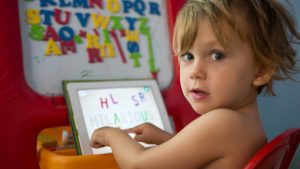
I experience from my own feel that the get-go place to start is to acquire the language yourself. Dissimilar having your kid play the pianoforte, or take trip the light fantastic toe lessons, learning a language does require to at least some extent agile participation from the parents.
I tin can appreciate and encourage my child's piano playing without knowing how to read a lick of music, but languages are all nearly advice. Information technology's not a requirement – I read i story about a child who learned 3 dissimilar local dialects from the gardener, nanny and cook in India – and his parents but spoke English.
But for most of united states, nosotros don't have an entourage of strange language speakers following us around. A cheap and affordable way to achieve this is to learn it yourself. You can assist your child to practise past speaking with them in the language, and as they get older you will understand and engage when they brainstorm to use these new words.
The second conclusion I came to was that my child would larn a little from strange language media (like watching the popular cartoon Xi Yang Yang in China – he learned the intro song quite well before we left) merely his language exploded when nosotros spent time speaking with native speakers.
Nosotros tried different things in each country, in part because I wanted to examination how things worked, and to be flexible and non commit as well heavily to whatsoever 1 set of rules. Yet information technology was amazing how much he learned with his Chinese ayi verses what he picked up from Lebanese children on the playground for an 60 minutes a day. The focused one-on-one conversation with his ayi and her consummate lack of English language meant that he started introducing Mandarin words much more quickly than he did with Arabic.
At the finish of the day, nosotros all have different resource and it becomes a question of what are y'all able to do… if you can introduce native speakers into the child's life that's platonic (and if that's you, consider yourself one of the lucky ones).
If you can acquire the language and speak information technology to your child regularly, this works well likewise. If you practise a combination of books, music, cartoons and other media in the target linguistic communication that is good exposure but about likely not enough to achieve bilingualism, at least as yous might define it as a native-like fluency.
Ultimately raising bilingual children for monolinguals, peculiarly in a monolingual culture (similar my dwelling country, the USA), means having either friends/neighbors who speak that linguistic communication, childcare in the language or a school system bachelor to you to assist.
If those things aren't an pick, whatever parent can however larn the language first mitt and routinely use it with their child. Even if you lot're not perfect. I know because my Standard mandarin, Standard arabic and Castilian all need quite a bit of piece of work before I'll consider myself fluent. Nonetheless it still works and you lot will learn as they larn (believe me, zip increases your vocabulary like an inquisitive toddler).
At that place are a lot of tools out there to assist kids learn, and I think they are useful, simply there needs to be at to the lowest degree 1 homo in their life that speaks the language. That's just my experience and recommendation simply popping in foreign-language-dubbed movies is not going to exist plenty.
Nosotros even accidently tested this theory during the 4 months nosotros spent in Lebanon where my son watched lots of French cartoons (he went through a large Garfield in French stage), merely never produced a single French word considering we didn't reinforce his French by speaking it with him – nosotros were there to larn Arabic.
How many languages can your children learn?

There'southward a limit and information technology comes not from the number of languages just the depth of understanding and vocabulary.
My son has no problem learning English, Standard mandarin, Arabic and Castilian, merely he'south just learning. A few words, a simple sentence, somewhen he'll speak them all at varying levels. Comprehension comes even faster than speaking.
But as adults, each of us have a lifetime of education in our native linguistic communication, spending years learning the grammer, increasing our vocabulary and learning how to express ourselves in the written word. Let's just take vocabulary for instance. I tin teach my son the word in Spanish for moon, cat, or spoon, no problem. But depending on the education he receives, his language in the classroom is going to chop-chop outpace my ability to keep upward.
Certain, I can figure out how to say "earthworm" for his biology class, but what about mathematics? Volition I take the time (and volition he let me) to explicate quadratic formulas in iii other languages? Will I practise that for all his subjects, all the way through high school? Unlikely.
Every bit a parent, I remember it's important to think about what language(s) y'all will want to focus on and what their utilize volition be.
For united states, we would like our son to be native-like fluent in Spanish and English. That means planning his education effectually this. Nosotros also want him to speak Mandarin and Standard arabic fluently (meaning with ease), and his early on exposure will help him internalize those tricky Standard mandarin tones and the poetic sounds of spoken Arabic.
However, realistically in those 2 languages, while he will exist conversationally fluent, his vocabulary will lag. He about likely won't learn to write in Mandarin until he'south older if at all, he won't become all the Arabic jokes kids tell each other because he won't grow upwards in the Middle Eastward. If he goes to university in 1 of those languages he will have to catch up to translate his specialized Spanish and English language vocabulary into the new language. We're okay with that.
We're prioritizing his language learning around one affair: communication.
Nosotros'd like to give him the ability to speak with lots of different people around the earth, simply every bit time goes on and nosotros experiment more with each language, it'southward clear that at that place are ever compromises to be made. While I could enroll him in Saturday Standard mandarin school, and Sunday Arabic class, I recollect speaking the linguistic communication is enough, for our family unit and our goals, and perhaps instead he tin can go play with his friends. At that place'due south a balance in there somewhere that we are still figuring out, but as any parent knows, you can't do it all.
Is at that place any benefit to learning a linguistic communication that isn't spoken in the land y'all alive in?
I retrieve there is. I'thousand not an academic so I won't go into the research (there are many exciting studies going on about the benefits for children).
All the same, just from watching my son, I call back learning any linguistic communication and getting that exposure helps you sympathise your start language amend. The commencement week we sent him to bilingual school he came home not simply speaking more than Castilian (of course we were thrilled at this) but besides speaking more than and better English language.
He was actually getting less exposure in English than earlier, just suddenly he was using new English words, excitedly telling us well-nigh his day, switching between languages to tell u.s. about his new "novia" and the rules at school, "no running!".
At that place'due south a lot more to be written about this, and I highly recommend reading François Grosjean's book Bilingual: Life and Reality. It clears up some of the myths and misconceptions near raising bilingual children and being bilingual in general – and he'due south a leading academic on the subject so everything he says is backed up with the latest research. (For case: childhood bilingualism doesn't lead to speech delays etc.)
I'yard writing my own book near my experiences, it volition be published with Penguin/Random House (they recently merged) and while I'grand non writing a how-to book, I am trying to collect every bit much information about how other people approach raising their children with multiple languages, how adults arroyo language learning and how academics who study this field approach language learning in their own lives or with their children if they have any.
If you are interested in participating, I accept three surveys — only complete the one that applies to you lot. If yous bank check "yes" for a follow up, I will exist interviewing as many people as possible over the coming days and weeks – but that's not required. Just tell me your story, I would honey to hear about how you have learned and used languages in your life. (Edit: The surveys are now closed)
Survey for those who speak 4+ languages
Survey for parents of bilingual children
Survey for language teachers, academics and researchers
If you merely want to follow my journey, I blog at almostfearless.com.

Source: https://www.fluentin3months.com/bilingual-child/
0 Response to "Benefits of Parents Reading With Their Child"
Post a Comment