Companies Can Improve the Triple Bottom Line With Sustainability by Minimizing What Fourã¢â‚¬â€¹ Things?

Unremarkably used schematics of the tripartite description of sustainability: Left, typical representation of sustainability every bit iii intersecting circles. Right, alternative depictions: literal 'pillars' and a concentric circles arroyo.[ane]
Sustainability is a broad policy concept in the global public soapbox that consists of three main "dimensions" or "pillars": environmental, economical and social.[one] The original semantic meaning of "sustainability" (a noun) and "to sustain" (a transitive verb) refers to the ability to keep over a long period of fourth dimension. A closely related and overlapping concept is that of "sustainable development". UNESCO formulated a distinction as follows: "Sustainability is often idea of as a long-term goal (i.e. a more sustainable world), while sustainable development refers to the many processes and pathways to achieve it."[2] According to the "Brundtland Report" Our Mutual Hereafter (1987), sustainable development is divers every bit development that "meets the needs of the present without compromising the power of future generations to run across their ain needs."[3] [iv]
The terms "sustainability" and "sustainable development" are increasingly pop in publications and on the internet, however, the problems to consider are complex.[five] The word of the ecology dimension of sustainability is often centered around prevailing issues. For instance, the dominant problems since the early on 2000s are climate change, loss of biodiversity, ecology degradation, the biogeochemical fluxes of nitrogen and phosphorus, and pollution, particularly plastic pollution.[6] : 21
Sustainability has likewise been described as an "wearied roadmap" due to the view that our consumer societies are socially and ecologically self-destructive.[vii] Moving towards sustainability can involve social challenges such as individual lifestyles and upstanding consumerism. Sustainable living approaches can reduce ecology impacts by altering the built surroundings to create more than sustainable cities. That would include sustainable transport and naught emission housing besides as sustainable architecture and round menses land use management.
Definitions and common utilize [edit]

Sustainability Venn diagram where "sustainability" is simplistically idea of equally the area where the three dimensions overlap.
Previous utilise of the term [edit]
Originally, "sustainability" meant making only such employ of natural, renewable resources that people could proceed to rely on their yields in the long term.[8] [9] The concept of sustainability, or Nachhaltigkeit in German, tin be traced back to Hans Carl von Carlowitz (1645–1714), and was applied to forestry.[10] However, the thought itself goes dorsum to times immemorial, as communities have ever worried almost the chapters of their surround to sustain them in the long term. Many ancient cultures had traditions restricting the utilise of natural resources, east.thousand. the Māori of New Zealand,[11] the Amerindians of coastal British Columbia and peoples of Indonesia, Oceania, India and Republic of mali.[12]
The pastoral constitution Gaudium et spes, published at the end of the 2d Vatican Quango in 1965, contains the starting time reference ever to the concept of sustainability.[13]
The term sustainability is derived from the Latin sustinere (tenere, to hold; sub, under). Sustain tin mean "maintain", "support", "uphold" or "endure."[14] [15]
Modern use equally a policy concept [edit]
Modern use of the term "sustainability" began with the 1983 Un Commission on Environment and Development, also known as the Brundtland Commission. In the committee's 1987 report titled Our Common Future (also known every bit the Brundtland Report), sustainable development is defined as evolution that "meets the needs of the present without compromising the power of future generations to see their own needs."[three] [iv] The study helped bring "sustainability" into the mainstream policy discourse and popularize the concept of "sustainable development".[ane]
The report states that environment and development are inseparable, when working for sustainability. Further, sustainable development is a global concept that links environmental and social issues and is equally important for developing countries and industrialized countries.
"the 'surround' is where we all live; and 'development' is what we all do in attempting to improve our lot within that abode. The two are inseparable."[iii] : Foreword [...] Nosotros came to run into that a new development path was required, i that sustained human being progress non just in a few pieces for a few years, but for the unabridged planet into the afar future. Thus 'sustainable development' becomes a goal not only for the 'developing' nations, merely for industrial ones every bit well."[3] : Section I.1.10
Relationship with the concept of sustainable development [edit]
The terms "sustainability" and "sustainable evolution" are closely related and practice overlap. For case, they are both now intrinsically linked with the "three dimensions of sustainability" concept.[sixteen] [ane] 1 stardom that could be made is that sustainability is a general concept, whereas sustainable evolution is a policy.
Sustainable evolution was first institutionalized with the "Rio Process" initiated at the 1992 Earth Pinnacle in Rio. Then in the yr 2000, the SDGs fully embraced sustainable development.[1] UNESCO formulated it as follows: "Sustainability is ofttimes idea of every bit a long-term goal (i.east. a more than sustainable world), while sustainable development refers to the many processes and pathways to attain it."[two]
Dimensions of sustainability [edit]
Development of iii dimensions (or pillars) concept [edit]

Three different dimensions (also called "pillars" or "aspects") of sustainability are commonly distinguished: the environmental, the social, and the economic. Most concepts of sustainability share this understanding, even though they might differ in the details. Several terms are in utilize for this concept in the literature: authors speak of three interconnected pillars, dimensions, components, stool legs, aspects, perspectives, factors or goals.[1] They are used interchangeably.[ane] For case, the 2005 World Summit Upshot document used the term "aspects".[eighteen] Nevertheless, the distinction itself is rarely existence questioned. The emergence of the three-pillar epitome has little theoretical foundation nor a theoretically rigorous clarification: It gradually emerged without a single signal of origin.[1] [nineteen]
The Brundtland report from 1987 emphasized that environs and development should be regarded inseparable. Furthermore, the Agenda 21 from 1992 explicitly talks well-nigh "economic, social and environmental dimensions" as follows:[20] : viii.half-dozen
"Countries could develop systems for monitoring and evaluation of progress towards achieving sustainable development by adopting indicators that measure out changes beyond economic, social and ecology dimensions."
The "2030 Agenda" conceived the 17 Sustainable Development Goals (SDGs) with their 169 targets every bit balancing "the three dimensions of sustainable development, the economic, social and environmental."[21]
The iii dimensions are sometimes also referred to as "people, planet, and prosperity" every bit the preamble of the Agenda 2030 refers to it, adding peace and partnership in its preamble.[21] : two
Environmental dimension [edit]
The increasing environmental pollution in the 1960s and 1970s led to growing environmental concern, eastward.k. Rachel Carson'south volume Silent Bound in 1962;[22] establishment of the Club of Rome in 1968; establishment of Greenpeace in 1971 and provided the ground for what was later discussed as sustainable evolution. This has been summarized equally follows: "The concern for the well-being of the world itself emerged in the 1970s, initially focused on natural resources and the human environment, and subsequently extended to the complex systems that back up life on Earth."[6] : 31
While environmental pollution is not a new phenomenon information technology had remained on a local or regional level for most of homo history. This changed in the 20th century, when the awareness of the global character of environmental issues increased.[vi] : 5 The harmful effect and global spread of pesticides like DDT was already discussed in the 1960s.[22] In the 1970s information technology was detected that chlorofluorocarbons (CFCs) deplete the Earth's ozone layer, which led to their de facto-ban by the Montreal Protocol in 1987.[16] : 146 The event of greenhouse gases on the global climate had already been discussed by Arrhenius in the early on 20th century (meet also history of climate modify science).[23] Nevertheless, climate alter became a hot topic in the academic and political discourse only after the institution of the IPCC in 1988 and the United nations FCCC in 1992.
In 1972, the UN held its offset conference on environmental issues, the Un Conference on the Man Surround. The conference declared that the "protection and improvement of the human surround is a major issue which affects the well-existence of peoples and economical development throughout the world"[24] : chapter I, I.2, page 3 The importance of the environmental dimension is axiomatic by the various functions the ecosphere provides: the "natural resources of the earth, including the air, h2o, state, flora and animate being and … natural ecosystems" which "must be safeguarded for the benefit of nowadays and future generations".[24] : p.four., Principle 2 Furthermore, the written report likewise stated that "the Earth's capacity to produce renewable resources must be maintained, the heritage of wildlife be protected, the discharge of toxic substances must exist halted, pollution prevented etc".[24] : p.four., Principle 3
The discussion of the environmental dimension of sustainability in public is oftentimes centered around prevailing issues. Since around the twelvemonth 2000, the well-nigh dominant issues in that respect are climate change, loss of biodiversity, the biogeochemical fluxes of nitrogen and phosphorus, and pollution, especially plastic pollution. The public is concerned well-nigh human impacts on the temper, land and water resources, the bioaccumulation of toxic substances, species loss and the degradation of ecosystems.[six] : 21
The overall impact of humans' activities non just on the biosphere but even on the geological formation of the Earth led Paul Crutzen to speak of the current geological epoch as the Anthropocene.
There are ii major ways of reducing negative human touch on and enhancing ecosystem services and the starting time of these is environmental direction. This direct approach is based largely on data gained from world science, ecology science and conservation biology. Nevertheless, this is management at the terminate of a long series of indirect causal factors that are initiated by human consumption, so a second arroyo is through demand management of human resource use.
Measuring human impacts on the environs [edit]
Different ways have been suggested to measure humans' impact, eastward.g. ecological footprint, ecological debt, conveying capacity, sustainable yield, I = PAT. The impact of human being activeness on the global ecosystems can reach tripping points across which irreversible harmful developments will exist triggered. This is the idea behind the concept of planetary boundaries. Therefore, it is important to avoid exceeding the planetary boundaries and strengthen ecological resilience - the chapters of an ecosystem to absorb disturbance and all the same retain its basic construction and viability.
In 2009 a group of scientists led by Johan Rockström from the Stockholm Resilience Centre described nine planetary boundaries. Transgressing fifty-fifty one of them can be unsafe to sustainability. Those boundaries are climatic change, biodiversity loss (changed in 2022 to "change in biosphere integrity"), biogeochemical (nitrogen and phosphorus), ocean acidification, land employ, freshwater, ozone depletion, atmospheric aerosols, chemical pollution (changed in 2022 to "Introduction of novel entities").[25] [26]
Similarly, in 2005, twelve main problems were described that tin be unsafe to environmental sustainability: Deforestation and habitat destruction, soil problems (erosion, salinization, and soil fertility losses), water management problems, overhunting, overfishing, effects of introduced species on native species, overpopulation, increased per-capita impact of people, climatic change, buildup of toxins in the surroundings, energy shortages, full human apply of the Earth's photosynthetic capacity.[27]
Three wide criteria for ecological sustainability were described in 1990: renewable resources should provide a sustainable yield (the rate of harvest should not exceed the charge per unit of regeneration); for non-renewable resources there should be equivalent evolution of renewable substitutes; waste material generation should non exceed the assimilative chapters of the surroundings.[28]
Salubrious ecosystems provide vital goods and services to humans and other organisms. The Millennium Ecosystem Cess from 2005 measured 24 ecosystem services and concludes that only four accept shown comeback over the last 50 years, 15 are in serious decline, and five are in a precarious condition.[29] : 6–nineteen
Economic dimension [edit]
The economic dimension of sustainability is closely related to the controversial character of the concept of sustainability itself.[i] If the term "evolution" in sustainable development is understood in economic terms ("economic development") or even identified with economical growth, the notion of a sustainable development can become a mode of whitewashing an ecologically destructive economic system.[30] [31] [32] This is considering of the inherent contradictions between "welfare for all" and environmental conservation.[33]
On the other manus, particularly the to the lowest degree developed countries will need to see considerable economic development, equally Target 1 of Sustainable Evolution Goal 8 demands, since economical growth has often been driving societal progress and well-existence (Target viii.1 is: "Sustain per capita economic growth in accord with national circumstances and, in particular, at least 7 per cent gross domestic product growth per annum in the least developed countries").[34] Regardless of any differences in the understanding of the concept of sustainability, it is clear that humanity will have to resolve the issue of how societal progress (potentially past economical development) can be reached without additional strain on the environment. Appropriately, UNEP stated in 2011 that information technology is a big challenge to society to "aggrandize economic activities" while at the same time reducing the use of natural resources and the environmental impacts of these economic activities.[35] : 8
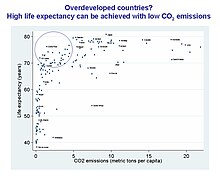
High life expectancy tin be achieved with low CO2 emissions, for example in Costa rica, a country which too ranks loftier on the Happy Planet Index.
In order to resolve this dilemma, the concept of eco-economical decoupling comes into play. This means "using less resources per unit of measurement of economic output and reducing the environmental impact of any resource that are used or economical activities that are undertaken" [35] : 8 Environmental pressure level is oft measured by using emissions of pollutants, and accordingly decoupling is frequently measured past the emission intensity of economic output.[35] Examples of absolute long-term decoupling are rare, but recently some industrialized countries have decoupled GDP growth from both production and, to a lesser extent, consumption-based CO2 emissions.[36] But fifty-fifty in this example decoupling alone is non sufficient just needs to be complemented past "sufficiency-oriented strategies and strict enforcement of absolute reduction targets".[37] : 1
The decoupling of economic growth from ecology deterioration is particularly difficult considering environmental and social costs are not more often than not borne by the entity that causes them, and are therefore not expressed in the market price.[38] In economics this is known as externalities, in this case negative externalities.[39] They demand to be addressed by government intervention: either by taxing the action (the polluter pays), by subsidizing activities that have a positive environmental or social effect (rewarding stewardship), or past outlawing the practice (legal limits on pollution, for case).[38] This arroyo is underlined in the following quote from a popular textbook on environmental economic science: "Nobody who has seriously studied the issues believes that the economic system's relationship to the natural environment can be left entirely to market forces".[twoscore] : 15
Environmental economics [edit]
Different methods for calculating an appropriate price for public natural goods are being practical in ecology economics. For example, the damage of ecosystems and the loss of biodiversity has huge economic implications as has been calculated in the project "The Economic science of Ecosystems and Biodiversity" (TEEB) from 2007 to 2011.[41]
Sustainability economics means taking a long-term view of man welfare. I mode of doing this is past considering the social disbelieve rate, i.e. the rate by which future costs and benefits should be discounted when making decisions about the future. The more one is concerned near futurity generations, the lower the social discount rate should be.[42] Another method is to quantify the services that ecosystems provide to humankind and put an economic value on them, so that environmental impairment may be assessed against perceived short-term welfare benefits. For instance, according to the World Economic Forum, half of the global GDP is strongly or moderately dependent on nature. Too, for every dollar spent on nature restoration at that place is a profit of at to the lowest degree 9 dollars.[43]
UNEP and UNDP launched the Poverty-Environment Initiative in 2005, which aims at the triple vision of "cipher extreme poverty, zippo net greenhouse gas emissions, zero net natural asset loss" which is proposed to guide the structural reform that will enable poor groups and countries to achieve the SDGs at scale.[44] [45] : 11 Such initiatives might be seen as a measure to mitigate the merchandise-off between high ecological footprint and high condition of economic development.[xvi] : 82

The doughnut economics template used for Planet Globe every bit a whole, indicating errors in red.
In recent years, the concept of doughnut economics has been adult by the British economist Kate Raworth to integrate social and environmental sustainability into economic thinking. The social dimension is here portrayed as a minimum standard to which a guild should aspire, whereas an outer limit is imposed past the carrying capacity of the planet.[46]
[edit]
The social dimension of sustainability is the least defined and least understood dimension (besides called "pillar" or "aspect") of the three dimensions commonly used to characterize sustainability.[47] Its significant and application continues to lead to confusion.[47] A quite generic definition is "maintaining or improving the well-being of people in this and future generations".[48] : 224–225 Others have pointed out that a "common agreement on the definition and operationalization of this concept is notwithstanding missing".[49]
Co-ordinate to the Brundtland report, "poverty is a major cause and effect of global ecology problems. It is therefore futile to endeavour to bargain with environmental issues without a broader perspective that encompasses the factors underlying world poverty and international inequality."[3] : Section I.ane.8 The report demands a new development path for sustained human progress and highlights that this is a goal for both the developing and the industrialized nations.[3] : Section I.1.10 Despite this anchoring of the social dimension (of sustainability) in the Brundtland study, "social sustainability" can be addressed in different means. Some scholars place social issues at the very heart of sustainability discussions.[50]
Some scholars propose that all of the domains of sustainability are social: including ecological, economic, political and cultural sustainability. These domains of social sustainability are all dependent upon the relationship between the social and the natural, with the "ecological domain" defined as human embeddedness in the environs. In these terms, social sustainability encompasses all human activities.[51] It is not only relevant to the focused intersection of economics, the environs and the social.[52]
Wide-based strategies for more than sustainable social systems include: improved education and the political empowerment of women, particularly in developing countries; greater regard for social justice, notably equity between rich and poor both within and betwixt countries; and, maybe most of all, intergenerational equity.[53]
Co-ordinate to the Western Australia Council of Social Services (WACOSS): "Social sustainability occurs when the formal and informal processes; systems; structures; and relationships actively support the capacity of electric current and futurity generations to create good for you and liveable communities. Socially sustainable communities are equitable, diverse, connected and democratic and provide a practiced quality of life."[54] [55]
Human relationship between the three dimensions [edit]
Information technology has long been discussed what the relation between these three dimensions should be: Proponents of a concept of "weak" sustainability assume that "natural capital" (or environmental resources) tin can exist replaced or substituted with "homo-made majuscule".[56] This is because technological progress can in certain cases solve environmental problems. This applies for example to capturing emissions from combustion of fossil fuels, recycling minerals, reforresting forests and filtering polluted air.[57] The concept of "strong sustainability" on the other hand states that nature (or "natural capital") provides some functions that are non replaceable by technology or "human-made capital".[58] Strong sustainability refers to resources that once lost cannot be recovered or repaired within a reasonable timescale, such as biodiversity or loss of certain species, pollination, fertile soils, assimilation capacity, clean air, clean water, climate regulation.
Yet, the concept of planetary boundaries which was first proposed in 2009, identifies limits and emphasizes that there are absolute thresholds of the carrying capacity of the planet which must not exist exceeded in order to preclude irreversible harmful developments of the Earth organization.[25]
Also, with regards to the economic dimension of sustainability, this can be understood past making a distinction between weak versus strong sustainability.[59] In the old, loss of natural resources is compensated past an increment in human capital. Strong sustainability applies where man and natural capital are complementary, just non interchangeable. Thus, the problem of deforestation in England due to demand for wood in shipbuilding and for charcoal in iron-making was solved when ships came to be built of steel and coke replaced charcoal in iron-making – an example of weak sustainability. Prevention of biodiversity loss, which is an existential threat, is an example of the stiff type. What is weak and what is strong depends partially on applied science and partially on one'due south convictions.[59] Different policies and strategies are needed for the two types.
Critique [edit]
The concept of sustainable evolution has been criticized from different angles. While some see it as paradoxical and regard development as inherently unsustainable, others are sobered by the lack of progress which has been achieved and then far.[60] [61] [62]
According to Dennis Meadows, one of the authors of the outset report to the Lodge of Rome, called "The Limits to Growth", many people deceive themselves past using the Brundtland definition of sustainability.[30] This is because the needs of the present generation are actually not met today, and the economic activities to meet present needs will substantially diminish the options of futurity generations.[63] [16] : 27 Sustainability has also been described as an "exhausted roadmap" due to the fact that our consumer societies are socially and ecologically self-destructive.[64]
Some scholars accept fifty-fifty proclaimed the finish of the concept of sustainability due to the realities of the Anthropocene: These realities include "unprecedented and irreversible rates of homo induced biodiversity loss, exponential increases in per-capita resource consumption, and global climate change".[65] Therefore, it might become incommunicable to pursue a goal of sustainability when faced with these complex, radical and dynamic issues.[65]
The Rio Process was a huge bound forwards: for the beginning time, the earth agreed on a sustainability agenda. Nonetheless, global consensus was facilitated by neglecting concrete goals and operational details."[16] : 136 The Sustainable Development Goals (SDGs) now accept concrete targets (dissimilar the results from the Rio Process) simply no methods for sanctions.[sixteen] : 137
Variations [edit]

Additional dimensions [edit]
Some sustainability experts and practitioners take proposed additional dimensions of sustainability. A common one is culture, resulting in a quadruple lesser line.[67] There is too an opinion that considers resource use and financial sustainability equally two additional pillars of sustainability.[68] In infrastructure projects, for instance, 1 must ask whether sufficient financing capability for maintenance exists.[68]
Another model suggests humans' attempt to accomplish all of their needs and aspirations via seven modalities: economy, community, occupational groups, government, environment, civilisation, and physiology.[69] From the global to the individual human scale, each of the seven modalities tin be viewed across seven hierarchical levels. Homo sustainability can exist accomplished by attaining sustainability in all levels of the vii modalities.
Cultural dimension as a fourth dimension [edit]
Working with a different emphasis, some researchers and institutions have pointed out that a time should be added to the dimensions of sustainable development, since the triple-lesser-line dimensions of economic, ecology and social exercise not seem to be enough to reflect the complexity of contemporary society. An case of this iv-dimensional view is the Circles of Sustainability approach, which includes cultural sustainability.[70] In this context, the Agenda 21 for civilisation and the United Cities and Local Governments (UCLG) published the policy statement "Culture: Fourth Pillar of Sustainable Evolution", at the 2010 World Congress of UCLG. This certificate argues for a new perspective and points to the relation between civilization and sustainable development through developing a solid cultural policy and advocating a cultural dimension in all public policies. The Circles of Sustainability arroyo distinguishes the four domains of economic, ecological, political and cultural sustainability.[71] [72] [73] This is in accord with the United nations, Unesco, Agenda 21, and in detail the Agenda 21 for culture which specifies culture as the fourth domain of sustainable development.[67] The model is now being used by organizations such every bit the Un Cities Program[74] and Metropolis.[75]
In the case of Metropolis, this approach does not mean calculation a fourth domain of culture to the dominant triple bottom line figure of the economic system, environment and the social. Rather, it involves treating all four domains—economy, ecology, politics, and civilisation—every bit social (including economics) and distinguishing between ecology (as the intersection of the human and natural worlds) and the environs equally that which goes far across what we equally humans tin can e'er know.[76]
Other organizations have also supported the idea of a fourth domain of sustainable development. The Network of Excellence "Sustainable Development in a Diverse Globe",[77] sponsored by the European union, integrates multidisciplinary capacities and interprets cultural diversity as a fundamental element of a new strategy for sustainable development.
Wellness and wellbeing [edit]
The World Health Organization recognizes that achieving sustainability is impossible without addressing health issues.[78] There is a ascent in some interconnected health and sustainability problems, for example, in food production. Measures for achieving ecology sustainability can in many cases also improve health.[79]
For ameliorate measuring the well-being, the New Economics Foundation's has launched the Happy Planet Index.[eighty] In the showtime of the 21st century, more 100 organizations created the Wellbeing Economy Alliance with the aim to create an economic system that volition guarantee well-being and heal nature at the same time.[81]
Measurement [edit]
Sustainability measurement is the quantitative basis for the informed direction of sustainability.[82] The metrics used for the measurement of sustainability (involving the sustainability of environmental, social and economic domains, both individually and in various combinations) are nevertheless evolving: they include indicators, benchmarks, audits, sustainability standards and certification systems like Fairtrade and Organic, indexes and bookkeeping, as well as assessment, appraisal[83] and other reporting systems. They are applied over a wide range of spatial and temporal scales.[84] [85] Some of the widely used sustainability measures include corporate sustainability reporting, Triple Bottom Line accounting, World Sustainability Society, and estimates of the quality of sustainability governance for individual countries using the Environmental Sustainability Index and Environmental Functioning Index. An alternative approach, used by the Un Global Compact Cities Programme and explicitly disquisitional of the triple-bottom-line approach is Circles of Sustainability.[86] [87]
Barriers [edit]
Barriers working against sustainability can exist rooted in nature, in the human status, in society, in the institutions or in Zeitgeist.[16] : 205 Some barriers are inevitably tied to the concept of sustainability due to trade-offs, complexity and alien interests. These barriers are intrinsic to the concept of sustainability equally such. Other barriers are extrinsic to the concept of sustainability which means they could in principle be overcome, eastward.thou. past putting a toll tag on the consumption of public appurtenances.[xvi] : 35
Pathways to achieving more sustainability [edit]
Scales [edit]
Sustainability is studied and managed over many scales (levels or frames of reference) of time and space and in many contexts of ecology, social, and economic organizations. The focus ranges from the total conveying capacity (sustainability) of planet Globe to the sustainability of economical sectors, ecosystems, countries, municipalities, neighborhoods, home gardens, individual lives, individual goods and services, occupations, lifestyles, and behavior patterns. Sustainability can entail the full compass of biological and human activeness or whatsoever office of it.[88]
Modifying affluence, population and engineering [edit]
One attempt to express human impact mathematically was adult in the 1970s and is called the I = PAT formula.[89] This formulation attempts to explain human consumption in terms of 3 components: population numbers, levels of consumption (which it terms "affluence", although the usage is different), and bear on per unit of resources employ (which is termed "applied science", because this touch depends on the technology used). The equation is expressed:
-
-
-
-
-
-
-
- I = P × A × T
-
-
-
-
-
-
-
-
- Where: I = Ecology impact, P = Population, A = Affluence, T = Technology[89]
-
Strategies for reaching sustainability can more often than not be divided into 3 categories. Well-nigh governments and international organizations that aim to reach sustainability employ all three approaches, though they may disagree on which deserves priority.
Abundance: Many believe that sustainability cannot be achieved without reducing consumption. This theory is represented nearly clearly in the idea of a steady-country economy, meaning an economic system without growth. Methods in this category include, among others, the phase-out of lightweight plastic bags, promoting biking, and increasing energy efficiency. For example, according to the report "Plastic and Climate", plastic-production greenhouse gas emissions can exist every bit much every bit 15% of world'due south remaining carbon upkeep past 2050 and over 50% past 2100, except the impacts on phytoplankton.[xc] [91] The study says that for solving the problem, reduction in consumption volition be essential.[92] In 2020, scientific inquiry published by the Earth Economic Forum determined that affluence is the biggest threat to sustainability.[93]
Population: Others think that the most effective ways of achieving sustainability is population control, for example by improving admission to nascence control and education (particularly education for girls).[94] Fertility rates are known to decline with increased prosperity, and have been declining globally since 1980.[ citation needed ]
Technology: Notwithstanding others hold that the almost promising path to sustainability is new engineering science. This theory may be seen equally a grade of technological optimism. One popular tactic in this category is transitioning to renewable energy.[95] [96] Others methods to attain sustainability, associated with this theory are climate engineering science (geo – engineering), genetic engineering (GMO, Genetically modified organism), decoupling.
Responses past different stakeholders [edit]
Businesses [edit]
The three dimensions of sustainability accept served as a common footing for numerous sustainability standards and certification systems, in detail in the food industry.[97] [98] Standards which today explicitly refer to the triple lesser line include Rainforest Alliance, Fairtrade, UTZ Certified, and GLOBALG.A.P.[99] [100] Sustainability standards are used in global supply chains in diverse sectors and industries such as agriculture, mining, forestry, and fisheries. Based on the ITC Standards, the about frequently covered products are agricultural products, followed by processed food.[101] [102]
Sustainable business practices integrate ecological concerns with social and economic ones (i.due east., the triple lesser line).[103] [104] The idea of sustainability as a business opportunity has led to the formation of organizations such as the Sustainability Consortium of the Society for Organizational Learning,[105] the Sustainable Business Plant,[106] and the Globe Quango for Sustainable Evolution.[107] The expansion of sustainable business concern opportunities tin can contribute to task creation through the introduction of greenish-neckband workers.[108]
The concept of "embedded sustainability" is defined as "incorporation of ecology, health, and social value into the core business with no trade-off in price or quality—in other words, with no social or green premium."[109] Embedded sustainability offers at to the lowest degree seven distinct opportunities for business organisation value creation: better risk-direction, increased efficiency through reduced waste and resource utilize, better product differentiation, new market entrances, enhanced make and reputation, greater opportunity to influence industry standards, and greater opportunity for radical innovation.[110]
Certifications [edit]
The United nations Guiding Principles on Business organization and Human Rights include a reporting framework,[111] which teaches companies how to report their interaction with homo rights bug. In addition resources like the Global Reporting Initiative, and Concern and Human Rights Resource Heart all provide information on organizational disclosures and performance in social sustainability.[112] Certifications from internationally recognized and accredited organizations are available to assistance in verifying the social sustainability of products and services. The Forest Stewardship Council (paper and forest products),[113] and Kimberly Process (diamonds) are examples of such organizations and initiatives.[114]
Application of social sustainability requires stakeholders to look at human and labor rights, prevention of human trafficking, and other homo rights risks.[115] These issues should be considered in production and procurement of various worldwide bolt. Many industries have organizations in place that assist in verifying the social sustainability of products and services.[116] The Equator Principles (fiscal manufacture), Fair Wear Foundation (garments), and Electronics Manufacture Citizenship Coalition are examples of such organizations and initiatives. Resources are also available for verifying the life-wheel of products and the producer or vendor level.[115]
Investments [edit]
The different aspects of social sustainability are often considered in socially responsible investing (SRI). Social sustainability criteria that are usually used by SRI funds and indexes to charge per unit publicly traded companies include: community, diversity, employee relations, human rights, production safe, reporting, and governance structure.[117] [118]
[edit]
In that location are at least 3 main warning publications or letters from the scientific community well-nigh the growing threat to sustainability, in item with regards to the environmental dimension of sustainability.
- In 1992, scientists wrote the get-go World Scientists' Alert to Humanity, which begins: "Human beings and the natural world are on a standoff course." Well-nigh i,700 of the globe's leading scientists, including nearly Nobel Prize laureates in the sciences, signed it. The letter mentions severe damage to temper, oceans, ecosystems, soil productivity, and more. Information technology warns humanity that life on globe every bit nosotros know it tin can become impossible, and if humanity wants to preclude the damage, some steps need to be taken: amend use of resources, abandon of fossil fuels, stabilization of human population, elimination of poverty and more.[119]
- In 2017, the scientists wrote a 2d warning to humanity. In this warning, the scientists mention some positive trends like slowing deforestation, but despite this, they claim that except ozone depletion, none of the bug mentioned in the first warning received an adequate response. The scientists called to reduce the use of fossil fuels, meat, and other resources and to stabilize the population. It was signed past 15,364 scientists from 184 countries, making it the letter with the nearly scientist signatures in history.[120]
- In November 2019, more than than xi,000 scientists from 153 countries published a letter of the alphabet in which they warn near serious threats to sustainability from climate change unless big changes in policies happen. The scientists alleged "climate emergency" and called to end overconsumption, motility away from fossil fuels, eat less meat, stabilize the population, and more.[121]
In 2022 the Un Environment Programme issued a report describing iii major ecology threats to sustainability: climate change, biodiversity loss and pollution. The report states that equally of the yr 2022 humanity fails to properly address the main ecology challenges. The COVID-19 pandemic is also linked to environmental issues, including climate change, deforestation and wildlife trade.[122]
Religious communities [edit]
Within the context of Christianity, in the encyclical "Laudato si'", Pope Francis chosen to fight climate change and ecological degradation every bit a whole.[123] [124] He claimed that humanity is facing a severe ecological crisis and blamed consumerism and irresponsible development. The encyclical is addressed to "every person living on this planet."[125]
Buddhism includes many principles linked to sustainability.[126] The Dalai Lama has consistently chosen for strong climate action, reforestation, preserving ecosystems, a reduction in meat consumption. He alleged that if he will ever bring together a political political party information technology will be the green party and if Buddha returned to our globe at present: "Buddha would be green."[127] [128] The leaders of Buddhism issued a special declaration calling on all believers to fight climate modify and ecology destruction equally a whole.[129]
Run across also [edit]
- Listing of sustainability topics
- Outline of sustainability
By sector [edit]
References [edit]
- ^ a b c d e f g h i Purvis, Ben; Mao, Yong; Robinson, Darren (2019). "Three pillars of sustainability: in search of conceptual origins". Sustainability Science. 14 (3): 681–695. doi:10.1007/s11625-018-0627-5. ISSN 1862-4065.
 Text was copied from this source, which is bachelor under a Creative Commons Attribution 4.0 International License
 - ^ a b "Sustainable Evolution". UNESCO. 3 August 2015. Retrieved 20 January 2022.
{{cite web}}: CS1 maint: url-condition (link) - ^ a b c d e f United Nations General Assembly (1987) Report of the Earth Commission on Environment and Development: Our Common Future. Transmitted to the General Assembly as an Annex to certificate A/42/427 – Evolution and International Co-performance: Environment.
- ^ a b United nations General Associates (xx March 1987). "Report of the World Commission on Environment and Development: Our Common Time to come; Transmitted to the General Associates as an Annex to document A/42/427 – Evolution and International Co-performance: Surround; Our Common Time to come, Affiliate 2: Towards Sustainable Development; Paragraph one". Un General Assembly. Retrieved 1 March 2010.
{{cite web}}: CS1 maint: url-condition (link) - ^ "Google Books Ngram Viewer". books.google.com.
{{cite web}}: CS1 maint: url-status (link) - ^ a b c d Neat transition : the promise and lure of the times ahead. Paul Raskin, Global Scenario Group. Boston: Stockholm Environment Institute. 2002. ISBN0-9712418-ane-three. OCLC 49987854.
{{cite volume}}: CS1 maint: others (link) - ^ Blühdorn (2017). "Mail service-capitalism, mail service-growth, post-consumerism? Eco-political hopes beyond sustainability". Global Soapbox. 7 (1): 42–61. doi:10.1080/23269995.2017.1300415. ISSN 2043-7897.
- ^ "Sustainability Theories". Globe Ocean Review. Retrieved 20 June 2019.
The concept of 'sustainability' comes from forestry and originally meant something like: using natural resource mindfully and then that the supply never runs out.
- ^ Compare: "sustainability". Oxford English Dictionary (Online ed.). Oxford Academy Printing. (Subscription or participating establishment membership required.) The English language-language word had a legal technical sense from 1835 and a resource-management connotation from 1953.
- ^ "Hans Carl von Carlowitz and Sustainability". Surround and Social club Portal . Retrieved twenty June 2019.
- ^ UNEP (26 April 2017). "Indigenous people and nature: a tradition of conservation". Retrieved thirty August 2021.
- ^ Gadgil, M.; Berkes, F. (1991). "Traditional Resource Management Systems". Resource Management and Optimization. 8: 127–141.
- ^ Bucciarelli, Edgardo (2011). "The Christian ethics of socio-economic evolution". The Periodical of Philosophical Economics. 5: ninety–119.
- ^ Harper, Douglas. "sustain". Online Etymology Dictionary.
- ^ Onions, Charles, T. (ed) (1964). The Shorter Oxford English Lexicon. Oxford: Clarendon Press. p. 2095.
- ^ a b c d due east f thou h Berg, Christian (2020). Sustainable action : overcoming the barriers. Abingdon, Oxon. ISBN978-0-429-57873-1. OCLC 1124780147.
- ^ Scott Cato, M. (2009). Green Economics. London: Earthscan, pp. 36–37. ISBN 978-1-84407-571-three.
- ^ "Resolution adopted past the General Assembly on 16 September 2005, 60/1. 2005 Earth Summit Consequence" (PDF). Un General Assembly. 2005. Retrieved 17 January 2022.
{{cite web}}: CS1 maint: url-status (link) - ^ Aachener Stiftung Kathy Beys, 2005-2022 (xiii Nov 2015). "Lexikon der Nachhaltigkeit | Definitionen | Nachhaltigkeit Definition". Lexikon der Nachhaltigkeit (in German). Retrieved 19 January 2022.
{{cite web}}: CS1 maint: numeric names: authors list (link) - ^ "Agenda 21" (PDF). United Nations Briefing on Environs & Evolution, Rio de Janeiro, Brazil, three to xiv June 1992. 1992. Retrieved 17 January 2022.
{{cite web}}: CS1 maint: url-status (link) - ^ a b Un (2015) Resolution adopted by the Full general Assembly on 25 September 2015, Transforming our globe: the 2030 Calendar for Sustainable Development (A/RES/lxx/1 Archived 28 November 2022 at the Wayback Machine)
- ^ a b Carson, Rachel (2002) [1st. Pub. Houghton Mifflin, 1962]. Silent Spring. Mariner Books. ISBN978-0-618-24906-0.
- ^ Arrhenius, Svante (1896). "XXXI. On the influence of carbonic acid in the air upon the temperature of the ground". The London, Edinburgh, and Dublin Philosophical Mag and Journal of Science. 41 (251): 237–276. doi:10.1080/14786449608620846. ISSN 1941-5982.
- ^ a b c United nations (1973) Written report of the United Nations Conference on the Human Environment, A/CONF.48/14/Rev.1, Stockholm, 5–sixteen June 1972
- ^ a b Steffen, Will; Rockström, Johan; Cornell, Sarah; Fetzer, Ingo; Biggs, Oonsie; Folke, Carl; Reyers, Belinda. "Planetary Boundaries - an update". Stockholm Resilience Centre . Retrieved xix April 2020.
- ^ "Ten years of ix planetary boundaries". Stockholm Resilience Centre . Retrieved 19 April 2020.
- ^ Jared Diamond, Collapse: How Societies Choose to Fail or Survive, Penguin Books, 2005 and 2011 (ISBN 978-0-241-95868-1).
- ^ Daly, H.E. (1990). "Toward some operational principles of sustainable development". Ecological Economics. 2 (1): ane–half dozen. doi:10.1016/0921-8009(90)90010-r.
- ^ Millennium Ecosystem Cess (2005). Ecosystems and Man Well-being: Biodiversity Synthesis (PDF). Washington, DC: World Resource Plant.
- ^ a b Zukunftsstreit (in German). Wilhelm Krull, Volkswagenstiftung (1st ed.). Weilerwist: Velbrück Wissenschaft. 2000. ISBN3-934730-17-five. OCLC 52639118.
{{cite volume}}: CS1 maint: others (link) - ^ Redclift, Michael (2005). "Sustainable development (1987-2005): an oxymoron comes of historic period". Sustainable Development. 13 (4): 212–227. doi:10.1002/sd.281. ISSN 0968-0802.
- ^ Daly, Herman Due east. (1996). Beyond growth : the economics of sustainable development (PDF). Boston: Beacon Printing. ISBN0-8070-4708-ii. OCLC 33946953.
- ^ Kuhlman, Tom; Farrington, John (2010). "What is Sustainability?". Sustainability. two (11): 3436–3448. doi:10.3390/su2113436. ISSN 2071-1050.
- ^ United nations (2017) Resolution adopted past the Full general Assembly on 6 July 2017, Piece of work of the Statistical Commission pertaining to the 2030 Agenda for Sustainable Evolution (A/RES/71/313)
- ^ a b c Decoupling natural resource use and environmental impacts from economical growth, A Report of the Working Group on Decoupling to the International Resources Panel. Fischer-Kowalski, M., Swilling, Thousand., von Weizsäcker, E.U., Ren, Y., Moriguchi, Y., Crane, W., Krausmann, F., Eisenmenger, N., Giljum, S., Hennicke, P., Romero Lankao, P., Siriban Manalang, A., Sewerin, S.
- ^ Haberl, Helmut; Wiedenhofer, Dominik; Virág, Doris; Kalt, Gerald; Plank, Barbara; Brockway, Paul; Fishman, Tomer; Hausknost, Daniel; Krausmann, Fridolin; Leon-Gruchalski, Bartholomäus; Mayer, Andreas (2020). "A systematic review of the evidence on decoupling of Gross domestic product, resource employ and GHG emissions, role Ii: synthesizing the insights". Environmental Research Letters. xv (half dozen): 065003. Bibcode:2020ERL....15f5003H. doi:10.1088/1748-9326/ab842a. ISSN 1748-9326. S2CID 216453887.
- ^ Haberl, Helmut; Wiedenhofer, Dominik; Virág, Doris; Kalt, Gerald; Plank, Barbara; Brockway, Paul; Fishman, Tomer; Hausknost, Daniel; Krausmann, Fridolin; Leon-Gruchalski, Bartholomäus; Mayer, Andreas (2020). "A systematic review of the evidence on decoupling of Gdp, resources utilize and GHG emissions, part II: synthesizing the insights". Environmental Research Letters. fifteen (6): 065003. Bibcode:2020ERL....15f5003H. doi:10.1088/1748-9326/ab842a. ISSN 1748-9326. S2CID 216453887.
- ^ a b Jaeger, William K. (2005). Environmental economics for tree huggers and other skeptics. Washington, DC: Isle Printing. ISBN978-1-4416-0111-7. OCLC 232157655.
- ^ Arthur Cecil Pigou (1932) The Economics of Welfare (4th ed.) London: Macmillan
- ^ Natural resources and environmental economics. Roger Perman, Roger Perman (quaternary ed.). Harlow, Essex: Pearson Addison Wesley. 2011. ISBN978-0-321-41753-4. OCLC 704557307.
{{cite book}}: CS1 maint: others (link) - ^ TEEB (2010), The Economic science of Ecosystems and Biodiversity: Mainstreaming the Economics of Nature: A Synthesis of the Approach, Conclusions and Recommendations of TEEB
- ^ Groth, Christian (2014). Lecture notes in Economical Growth, (mimeo), Chapter 8: Choice of social discount rate. Copenhagen Academy.
- ^ UNEP, FAO (2020). UN Decade on Ecosystem Restoration. 48p. https://wedocs.unep.org/xmlui/bitstream/handle/20.500.11822/31813/ERDStrat.pdf?sequence=1&isAllowed=y
- ^ "UN Environment | UNDP-UN Environs Poverty-Environment Initiative". Un Surroundings | UNDP-UN Environment Poverty-Environment Initiative . Retrieved 24 January 2022.
- ^ PEP (2016) Poverty-Environs Partnership Articulation Paper | June 2022 Getting to Zero - A Poverty, Surroundings and Climate Phone call to Action for the Sustainable Development Goals
- ^ Raworth, Kate (2017). Doughnut economics : seven means to think similar a 21st-century economist. London. ISBN978-1-84794-138-one. OCLC 974194745.
- ^ a b Boyer, Robert H. West.; Peterson, Nicole D.; Arora, Poonam; Caldwell, Kevin (2016). "Five Approaches to Social Sustainability and an Integrated Way Forward". Sustainability. 8 (ix): 878. doi:10.3390/su8090878.
- ^ Chiu, R.L. Chapter 12 Social Sustainability, Sustainable Evolution and Housing Development. In: Housing and social change. Due east-W perspective. Ray Forrest, James Lee. London: Routledge. 2003. ISBN0-203-40263-iv. OCLC 56741461.
{{cite volume}}: CS1 maint: others (link) - ^ Davidson, Mark (2010). "Social Sustainability and the City: Social sustainability and urban center". Geography Compass. 4 (vii): 872–880. doi:10.1111/j.1749-8198.2010.00339.x.
- ^ Boyer, Robert; Peterson, Nicole; Arora, Poonam; Caldwell, Kevin (2016). "Five Approaches to Social Sustainability and an Integrated Way Forward". Sustainability. 8 (9): 878. doi:ten.3390/su8090878. ISSN 2071-1050.
- ^ James, Paul; with Magee, Liam; Scerri, Andy; Steger, Manfred B. (2015). Urban Sustainability in Theory and Do: Circles of Sustainability. London: Routledge. ISBN9781315765747.
- ^ Liam Magee; Andy Scerri; Paul James; James A. Thom; Lin Padgham; Sarah Hickmott; Hepu Deng; Felicity Cahill (2013). "Reframing social sustainability reporting: Towards an engaged approach". Environment, Development and Sustainability. 15 (1): 225–243. doi:10.1007/s10668-012-9384-2. S2CID 153452740.
- ^ Cohen, J.E. (2006). "Human Population: The Next One-half Century." In Kennedy D. (Ed.) Science Magazine's Land of the Planet 2006-7. London: Island Press, pp. 13–21. ISBN 9781597266246.
- ^ Doğu, Feriha Urfalı; Aras, Lerzan (2019). "Measuring Social Sustainability with the Developed MCSA Model: Güzelyurt Case". Sustainability. 11 (9): 2503. doi:ten.3390/su11092503. ISSN 2071-1050.
- ^ "The Regional Institute - WACOSS Housing and Sustainable Communities Indicators Project". www.regional.org.au. 2012. Retrieved 26 January 2022.
- ^ Pearce, David W.; Atkinson, Giles D. (1993). "Capital theory and the measurement of sustainable development: an indicator of "weak" sustainability". Ecological Economic science. 8 (2): 103–108. doi:ten.1016/0921-8009(93)90039-ix.
- ^ Ayres, Robert; van den Berrgh, Jeroen; Gowdy, John (2001). "Strong versus Weak Sustainability". Environmental Ethics. 23 (2): 155–168. doi:ten.5840/enviroethics200123225. ISSN 0163-4275.
- ^ Cabeza Gutés, Maite (1996). "The concept of weak sustainability". Ecological Economic science. 17 (iii): 147–156. doi:x.1016/S0921-8009(96)80003-6.
- ^ a b Robert U. Ayres & Jeroen C.J.M. van den Bergh & John M. Gowdy, 1998. "Viewpoint: Weak versus Strong Sustainability," Tinbergen Institute Discussion Papers 98-103/3, Tinbergen Institute.
- ^ Brown, James H. (one Oct 2015). "The Oxymoron of Sustainable Development". BioScience. 65 (ten): 1027–1029. doi:10.1093/biosci/biv117.
- ^ "Sustainability and Sustainable Development". Circular Ecology . Retrieved 17 July 2018.
- ^ Williams, Colin C; Millington, Andrew C (June 2004). "The diverse and contested meanings of sustainable development". The Geographical Journal. 170 (2): 99–104. doi:x.1111/j.0016-7398.2004.00111.x. S2CID 143181802.
- ^ Gambino, Megan (15 March 2012). "Is it As well Late for Sustainable Development?". Smithsonian Mag . Retrieved 12 January 2022.
{{cite web}}: CS1 maint: url-status (link) - ^ Blühdorn (2017). "Post-capitalism, mail-growth, post-consumerism? Eco-political hopes beyond sustainability". Global Discourse. 7 (1): 42–61. doi:10.1080/23269995.2017.1300415. ISSN 2043-7897.
- ^ a b Benson, Melinda Impairment; Craig, Robin Kundis (2014). "The End of Sustainability". Society & Natural Resources. 27 (7): 777–782. doi:10.1080/08941920.2014.901467. ISSN 0894-1920. S2CID 67783261.
- ^ James, Paul; with Magee, Liam; Scerri, Andy; Steger, Manfred B. (2015). Urban Sustainability in Theory and Practise: Circles of Sustainability. London: Routledge. ISBN9781315765747.
- ^ a b United Cities and Local Governments, "Civilisation: Fourth Pillar of Sustainable Development".
- ^ a b Dhakal, Krishna P.; Oh, Jun South. (2011). "Integrating Sustainability into Highway Projects: Sustainability Indicators and Assessment Tool for Michigan Roads". T&DI Congress 2011. American Society of Civil Engineers. pp. 987–996. doi:10.1061/41167(398)94. ISBN 9780784411674.
- ^ Thomas, Steve A. (2016). The Nature of Sustainability. Chapbook Press. Grand Rapids, Michigan. ISBN 9781943359394.
- ^ James, Paul; Magee, Liam (2016). "Domains of Sustainability". In A. Farazmand (ed.). Global Encyclopedia of Public Assistants, Public Policy, and Governance. Springer.
- ^ United Cities and Local Governments, "Culture: Fourth Colonnade of Sustainable Development" Archived 10 August 2022 at the Wayback Machine.
- ^ "Principles for a Positive Urban Time to come".
- ^ James, Paul. "Assessing Cultural Sustainability: Agenda 21 for Culture".
- ^ Circles of Sustainability. citiesprogramme.com
- ^ Earth Clan of the Major Metropolises, Urban center. Retrieved 13 March 2016.
- ^ Metropolis Action Plan 2018–2020, at www.urban center.org James, Paul; Magee, Liam (2016). "Domains of Sustainability". In A. Farazmand (ed.). Global Encyclopedia of Public Administration, Public Policy, and Governance. Springer.
- ^ "Sus.Div". Sus.Div. Retrieved 28 September 2011.
- ^ Borowy, Iris (2014). "Sustainable wellness: the demand for new developmental models". Bulletin of the Globe Health Organisation. 92 (10): 699. doi:10.2471/BLT.fourteen.145219. PMC4208489. PMID 25378720. Archived from the original on nineteen October 2014. Retrieved 31 July 2019.
- ^ Kjӕrgård, Bente; Land, Birgit; Bransholm Pedersen, Kirsten (viii January 2013). "Health and sustainability". Health Promotion International. 29 (iii): 558–568. doi:10.1093/heapro/das071. PMID 23300191.
- ^ Belton, Teresa. "Why becoming a 'happily modest consumer' could help save the planet". World Economic Forum . Retrieved 24 May 2020.
- ^ Hough-Stewart, Lisa; Trebeck, Katherine; Sommer, Claire; Wallis, Stewart (three December 2019). What is a wellbeing economy? (PDF). pp. 1, 5–6. Retrieved 16 October 2020.
- ^ "Sustainability Accounting in United kingdom Local Government". The Association of Chartered Certified Accountants. Archived from the original on 11 April 2008. Retrieved eighteen June 2008.
- ^ Dalal-Clayton, Barry and Sadler, Barry 2009. Sustainability Appraisement: A Sourcebook and Reference Guide to International Experience. London: Earthscan. ISBN 978-1-84407-357-iii.[ page needed ]
- ^ Hak, T. et al. 2007. Sustainability Indicators, SCOPE 67. Island Press, London. [i] Archived 2011-12-xviii at the Wayback Motorcar
- ^ Bell, Simon and Morse, Stephen 2008. Sustainability Indicators. Measuring the Immeasurable? 2nd edn. London: Earthscan. ISBN 978-i-84407-299-half dozen.https://books.google.com/books/about/Sustainability_Indicators.html?id=6DOC13cd9c0C
- ^ Singh, Rajesh Kumar; Murty, H.R.; Gupta, South.K.; Dikshit, A.K. (2012). "An overview of sustainability assessment methodologies". Ecological Indicators. 15: 281–299. doi:10.1016/j.ecolind.2011.01.007.
- ^ Moldan, Bedřich; Janoušková, Svatava; Hák, Tomáš (2012). "How to understand and measure out ecology sustainability: Indicators and targets". Ecological Indicators. 17: 4–13. doi:10.1016/j.ecolind.2011.04.033.
- ^ Conceptual Framework Working Group of the Millennium Ecosystem Assessment. (2003). "Ecosystems and Human Well-beingness." London: Isle Press. Chapter 5. "Dealing with Scale". pp. 107–124. ISBN 9781559634038.
- ^ a b Ehrlich, P.R.; Holden, J.P. (1974). "Man Population and the global surroundings". American Scientist. Vol. 62, no. 3. pp. 282–292.
- ^ Plastic & Climate The Subconscious Costs of a Plastic Planet (PDF). Center for International Environmental Constabulary, Environmental Integrity Project, FracTracker Alliance, Global Alliance for Incinerator Alternatives, 5 Gyres, and Break Free From Plastic. May 2019. pp. four–5. Retrieved 20 May 2019.
- ^ "Sweeping New Report on Global Ecology Impact of Plastics Reveals Severe Harm to Climate". Centre for International Environmental Police (CIEL) . Retrieved 16 May 2019.
- ^ Plastic & Climate The Hidden Costs of a Plastic Planet (PDF). Center for International Ecology Law, Environmental Integrity Projection, FracTracker Brotherhood, Global Brotherhood for Incinerator Alternatives, five Gyres, and Pause Free From Plastic. May 2019. pp. 82–85. Retrieved 20 May 2019.
- ^ Fleming, Sean. "This is at present the world'due south greatest threat – and it'south non coronavirus". Globe Economic Forum. World Economical forum. Retrieved 5 August 2020.
- ^ Perkins, Sid. "The all-time fashion to reduce your carbon footprint is one the regime isn't telling you lot almost". Science . Retrieved 11 November 2019.
- ^ M. Parris, Thomas; W. Kates, Robert (8 July 2003). "Characterizing a sustainability transition: Goals, targets, trends, and driving forces". Proceedings of the National Academy of Sciences of the United States of America. 100 (14): 8068–8073. doi:x.1073/pnas.1231336100. PMC166183. PMID 12819346.
- ^ "The IPAT Equation". The Sustainable Calibration Project . Retrieved 13 May 2019.
- ^ Manning, S., Boons, F., Von Hagen, O., Reinecke, J. (2011). "National Contexts Matter: The Co-Evolution of Sustainability Standards in Global Value Chains." Ecological Economics, Forthcoming.
- ^ Reinecke, J., Manning, S., Von Hagen, O. (2012). "The Emergence of a Standards Market: Multiplicity of Sustainability Standards in the Global Coffee Industry" Organization Studies, Forthcoming.
- ^ SAI Platform 2010. Sustainability Indicators Archived 31 January 2012 at the Wayback Machine. Sustainable Agricultural Initiative. Retrieved 4 September 2011.
- ^ Alvarez, G. Sustainable Agriculture and Value networks. Lausanne, Switzerland: Latitude. Retrieved 4 Oct 2011.
- ^ "The Trade Bear upon of Voluntary Sustainability Standards: A review of empirical prove" (PDF).
- ^ "Sustainability Map". www.standardsmap.org . Retrieved 3 March 2021.
- ^ Kinsley, G. and Lovins, 50.H. (September 1997). "Paying for Growth, Prospering from Development." Archived 17 July 2011 at the Wayback Machine Retrieved 15 June 2009.
- ^ Sustainable Shrinkage: Envisioning a Smaller, Stronger Economic system. Thesolutionsjournal.com. Retrieved 13 March 2016.
- ^ Zhexembayeva, Northward. (May 2007). "Becoming Sustainable: Tools and Resource for Successful Organizational Transformation". Center for Business organisation as an Agent of Globe Benefit. Case Western University. Archived from the original on 13 June 2010.
- ^ "About Us". Sustainable Business Institute. Archived from the original on 17 May 2009.
- ^ "About the WBCSD". Globe Business Council for Sustainable Evolution (WBCSD). Archived from the original on 9 September 2007. Retrieved 1 April 2009.
- ^ Hickman, Leo (12 February 2009). "The futurity of work is dark-green". The Guardian.
- ^ Laszlo, Chris; Zhexembayeva, Nadya (25 April 2011). "Embedded Sustainability: A strategy for marketplace leaders". The European Financial Review.
- ^ Laszlo, C. & Zhexembayeva, N. (2011). Embedded Sustainability: The Next Big Competitive Advantage. Stanford, CA: Stanford University Printing. ISBN 0-804-77554-0
- ^ "Un Guiding Principles Reporting Framework". www.ungpreporting.org . Retrieved x March 2016.
- ^ "Social Sustainability - GSA Sustainable Facilities Tool". sftool.gov . Retrieved 10 March 2016.
- ^ "In Ivory Coast, the school as a barrier against kid labour". ICI Cocoa Initiative . Retrieved 19 June 2019.
- ^ "Social Sustainability Initiatives, Guidelines, and Standards - GSA Sustainable Facilities Tool". sftool.gov . Retrieved 10 March 2016.
- ^ a b "Resources for Verifying Sustainable Products – GSA Sustainable Facilities Tool". sftool.gov . Retrieved ten March 2016.
- ^ "Social Sustainability Initiatives, Guidelines, and Standards – GSA Sustainable Facilities Tool". sftool.gov . Retrieved ten March 2016.
- ^ KLD Research. Ecology, Social and Governance Rating Criteria. 2007
- ^ The Combined Lawmaking on Corporate Governance, June 2008
- ^ "Earth Scientist's Warning to Humanity" (PDF). Spousal relationship of Concerned Scientists. Matrimony of Concerned Scientists. Retrieved 11 November 2019.
- ^ Ripple, William J.; Wolf, Christopher; Newsome, Thomas G.; Galetti, Mauro; Alamgir, Mohammed; Crist, Eileen; Mahmoud, Mahmoud I.; Laurance, William F. (December 2017). "World Scientists' Warning to Humanity: A 2nd Notice". BioScience. 67 (12): 1026–1028. doi:10.1093/biosci/bix125.
- ^ J Ripple, William; Wolf, Christopher; M Newsome, Thomas; Barnard, Phoebe; R Moomaw, William (five November 2019). "Earth Scientists' Warning of a Climate Emergency". BioScience. biz088. doi:10.1093/biosci/biz088.
- ^ Making Peace with Nature: a scientific blueprint to tackle the climate, biodiversity and pollution emergencies (PDF). Nairobi: Un Environmental Programm. 2021. pp. xiii–17, 26. ISBN978-92-807-3837-seven . Retrieved 25 March 2021.
- ^ "Encyclical Letter Laudato Si' Of The Holy Father Francis On Intendance For Our Common Home (official English language-language text of encyclical)". Retrieved xviii June 2015.
- ^ "Laudato Si': On Intendance for Our Mutual Dwelling". SDG Academy. Sustainable Development Solutions Network. Retrieved 30 July 2020.
- ^ Yardley, Jim; Goodstein, Laurie (18 June 2015). "Pope Francis, in Sweeping Encyclical, Calls for Swift Activity on Climate Change". The New York Times.
- ^ "What does Buddhism teach nearly the environment?". BBC. Retrieved 25 January 2021.
- ^ "Dalai Lama says strong action on climate change is a human responsibility". Associated Press. The Guardian. xx October 2020. Retrieved 25 January 2021.
- ^ Guru-Murthy, Krishnan (11 November 2020). "'Buddha would be green': Dalai Lama calls for urgent climate activeness". The Guardian. Retrieved 25 January 2021.
- ^ "The Fourth dimension to Human action is At present A Buddhist Declaration on Climate change". One Earth Sangha. 20 September 2015. Retrieved nine May 2021.
Source: https://en.wikipedia.org/wiki/Sustainability
0 Response to "Companies Can Improve the Triple Bottom Line With Sustainability by Minimizing What Fourã¢â‚¬â€¹ Things?"
Post a Comment